

Model Training Overview
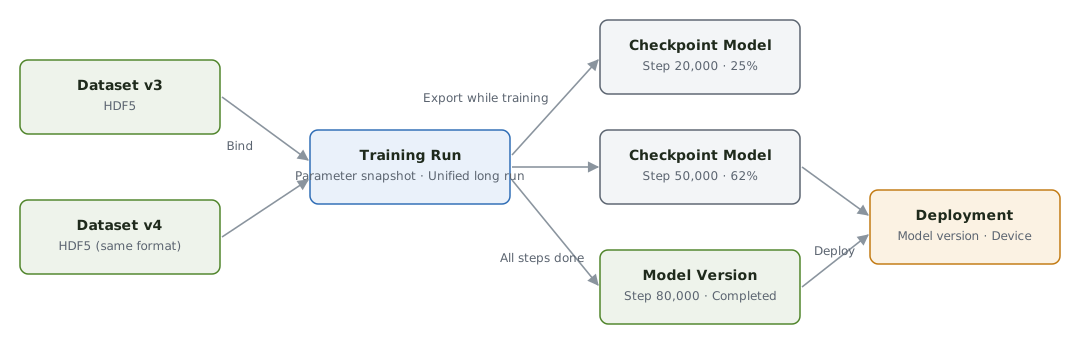
Model training turns frozen dataset versions into robot models. Each training run is a training job, which produces one or more model versions.
Key Concepts
| Concept | Description |
|---|---|
| Training input | One or more Exported dataset versions in the same format |
| Model family | The model architecture used for training, such as ACT, EasyDP, Pi 0.5, or R0 |
| Training strategy | The platform's unified "long-horizon, quality-first" strategy, which runs the full step budget (currently 80,000 steps) |
| Parameter snapshot | Steps, learning rate, batch size, optimizer, random seed, and dataset versions, locked at submission |
| Compute tier | Light, Standard, or High-performance instance configuration |
| Checkpoint | A snapshot of the weights at a given step, which can be registered as a model |
| Model version | A model registered when training completes or when a checkpoint is exported |
Why a Unified Training Strategy
NexCore doesn't offer fast, standard, or fine-grained training tiers. Every job trains at the same intensity:
- Comparable results: Results from different dataset versions and model families are produced under the same conditions and can be compared directly.
- No misleading conclusions: A short run only proves the pipeline works; it says little about model quality.
- Controlled pacing: You can export checkpoints at any time to check direction early, without waiting for training to finish.
Supported Model Families
| Model family | Characteristics | Recommended data format |
|---|---|---|
| ACT | Imitation learning with action chunking; well suited to precise bimanual manipulation | HDF5 |
| EasyDP | Diffusion policy; well suited to multimodal tasks with complex action distributions | HDF5 / LeRobot |
| Pi 0.5 | Vision-language-action (VLA) model; well suited to language-conditioned tasks or tasks that require generalization | LeRobot |
| R0 | Lumos Robotics' general-purpose manipulation model | HDF5 |
Supported combinations of model family and target device are listed in the platform's training templates.
Training Workflow
text
Prepare dataset versions → Create training job → Queue and train → Monitor and export checkpoints → Training complete → Model versionCreating Training JobsPreparing inputs, configuration options, compute tiers, and submission.Monitoring and CheckpointsStates, curves, logs, checkpoint export, and job comparison.Model ManagementView model versions produced by training and their lineage.Downloading Model ArtifactsDownload weights and inference configuration.