

Introduction to NexCore
NexCore is the embodied AI skill learning platform from Lumos Robotics. It brings every stage of teaching a robot a new skill into a single platform: collecting demonstrations, processing and curating data, training models, delivering models, and deploying them to real robots.
The platform produces three kinds of assets: datasets, models, and meta-skills.
Capabilities
| Capability | Description | Learn more |
|---|---|---|
| Egocentric data collection | Capture human demonstrations with Lumos Ego, UMI, and other robot-free devices | Egocentric Data Collection |
| Teleoperation data collection | Capture on-robot skill data by teleoperating Lumos robots such as Station Lite and MOS | Teleoperation Data Collection |
| Data upload and management | Organize data assets by collection task, with multi-dimensional filtering and management | Data Management |
| Data pipelines and processing jobs | Turn raw recordings into structured data with pipelines built from standard operators | Data Pipelines |
| Annotated data generation, management, and delivery | Generate, export, and download quality labels, time ranges, trajectories, depth, keypoints, and other annotations | Annotated Data and Delivery |
| Model training and job management | Train models on datasets using built-in model templates, with checkpoint export and continued training | Model Training |
| Model artifact management and download | Trace model lineage and download model artifacts | Models and Downloads |
| On-robot model deployment | Cloud or edge deployment with safety confirmation, on-site validation, and data feedback | On-Robot Deployment |
The Skill Learning Loop
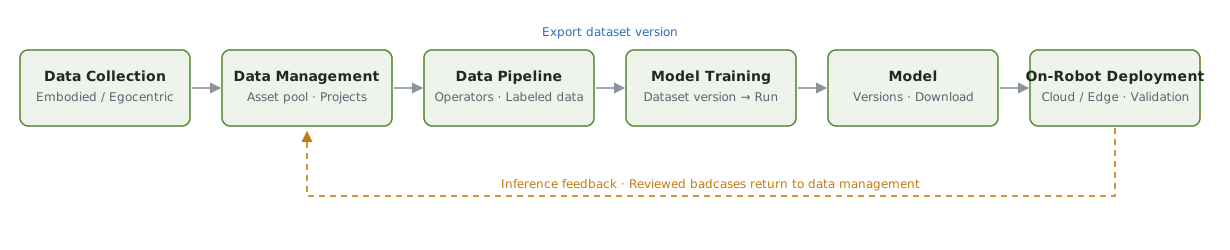
- Collect: Bind a collection task to a specific device, record demonstrations, and upload them.
- Manage: Uploaded data becomes data assets, traceable to the collection task that produced them. In a curation project, you flag quality issues, define time ranges, and review each episode.
- Process: Egocentric data passes through a data pipeline to produce structured data. No processing step ever modifies the original data.
- Train: Export curation results as a frozen dataset version and use it to create a training job, which produces a model version.
- Deploy: Deploy the model to the cloud or an edge node, then validate and run it on a real robot.
- Iterate: Execution data flows back automatically. Failure cases (bad cases) are reviewed and returned to data management for the next iteration.
Every stage records versions and lineage, so for any model you can answer: which data was used, how it was processed, and which version it is pinned to.
Who NexCore Is For
| Audience | Key questions | Start here |
|---|---|---|
| Enterprise and production customers | Can we collect data, train, and deploy skills in our own environment? | Tutorials |
| Research institutions and universities | Are the data formats open? Can we export datasets and models for our own experiments? | Data Formats · Downloading Models |
| Partners and system integrators | How do we connect devices and deploy models on site? | Device Management · On-Robot Deployment |
| Operations leaders | How does the platform drive productivity, and how should the team divide the work? | Core Concepts · Roles and Permissions |
| Skill developers | How do we build new models, pipelines, and skills? | Quick Start |
Platform Architecture
| Layer | Components |
|---|---|
| Devices and compute | Lumos-built collection and execution devices, including the Station Lite dual-arm workstation, the heavy-duty MOS mobile manipulator, and robot-free Ego and UMI devices; cloud training compute; on-site edge inference nodes |
| Platform tools | Collection tasks, data assets, curation projects, data pipelines, datasets, training jobs, model management, deployment, evaluation, and feedback |
| Model and skill assets | Datasets, models, skills |
| Access | Web console and edge client |
NexCore is served from a single domain, with compute and storage nodes deployed by region. Data is written to the storage nodes in its region, training jobs are scheduled onto available compute, and edge inference nodes only need outbound connectivity to the platform. For data that must remain entirely on premises, a private deployment is also available.
Design Principles
| Principle | What it means |
|---|---|
| Read-only source data | Curation and pipelines only produce metadata, instructions, and new outputs. Original data is always preserved. |
| Frozen versions | Datasets are frozen on export, and training binds only to frozen versions, so results are reproducible. |
| End-to-end lineage | Data IDs, dataset versions, model versions, and deployment records are linked at every step. |
| Open formats | Datasets export to open formats such as HDF5 and LeRobot, and model artifacts are downloadable. |
| Project isolation | Data is isolated by project and is not visible across projects. |
| Safety first | A safety confirmation is required before any on-robot run. |
Scope
- In addition to Station Lite and MOS, third-party robots can be integrated through adapters. The scope of each integration is assessed per project.
- NexCore provides the tools and assets. Scenario-specific solutions are built jointly by customers, partners, and field application engineers.